Black Mold Removal in American Fork, UT
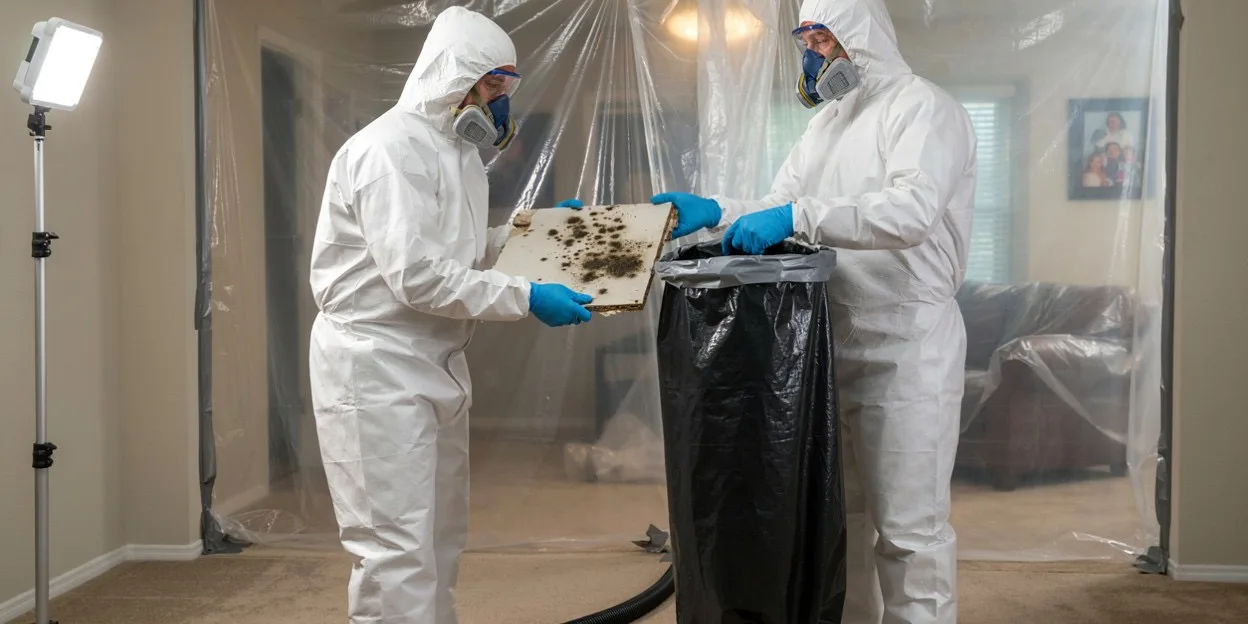
You moved the couch away from the basement wall and found a dark patch the size of a dinner plate, black at the center and gray at the edges. A search turned up frightening words. Set those aside. Color alone does not identify the species, and the species does not change what a crew does. Dark growth gets removed the same way any growth on a wet wall does. This site connects you by phone with an independent local provider who does black mold removal in American Fork and across Utah County.
What the crew does first
The crew starts with the moisture, not the color. A meter along the base of the wall and across the slab tells them how far the water went and whether the wall behind the drywall is still wet. Dark growth on a north wall in a finished basement almost always traces to a window well, a seep at the footing, or a cold exterior wall sweating behind the insulation.
Then they set up containment. The doorway is sealed with plastic, an air scrubber with a HEPA filter runs inside the zone as negative air, and the furnace return is covered. The crew wears respirators and suits inside the zone. That is the same setup used for any patch bigger than a few square feet; dark growth does not earn a different one.
What to do in the next hour
Leave it alone. Do not scrub it, do not spray bleach on it, and do not pull the baseboard to see how far it goes. Disturbing a large dark patch without containment puts spores into the return air, which is the one thing you can make worse.
Push the couch back a foot so air can move, close the door, and keep anyone with asthma or allergies out of the room. Photograph the patch with a ruler or a hand in the frame for scale. Look for the source: check the window well outside for standing water and the slab for a damp line.
What is usually saved and what is removed
Wet drywall, baseboard, carpet pad, and insulation come out, cut past the last wet reading and bagged inside the zone. Concrete, block, and solid framing get cleaned in place, HEPA vacuumed, and wiped. Anything porous that sat against the wall, like the back of a fabric couch, gets cleaned off-site or goes.
After removal, drying equipment runs until the foundation wall and the bottom plate read dry. The source gets handled as part of the job. If the patch turns out to be one corner of a wider problem across the basement, the job becomes basement mold remediation. When the wall is dry, mold damage repair puts it back.
Utah County notes: cold walls, old brick, and what the state does not license
Utah issues no separate mold license and has no rule that separates the company that looks at a dark patch from the company that removes it. The crew works under a state contractor license for the cutting and rebuild, and you can verify it before hiring.
The dark patches Utah County crews see most often sit low on north and east basement walls, where the concrete stays cold through winter and warm inside air condenses on it behind the drywall. In the 1900s to 1950s brick homes in downtown American Fork, Lehi, and Pleasant Grove, the same patch shows up on whitewashed stone foundation walls that weep after a wet spring.
Mold can aggravate allergies or breathing problems for some people. This site cannot tell you whether the patch in your basement is doing that; a doctor can. What the crew can do is remove it under containment and hand you photos and moisture logs for your own records or an insurer.
Calling about black mold removal
Have the address, the size of the patch, and where it is. Say whether the basement took water in the last year and whether anyone in the house is sensitive to mold. Call (385) 534-4662.